Cloud Migration: Why it’s more important now than ever

Cloud Migration

Cloud Migration means moving dataa, applications, or some other business elements to a cloud computing environment.

Cloud Computing…

Cloud Computing is the on-demand delivery of IT resources via the internet, with pay as you go pricing. The business organizations can benefit themselves with the use of Cloud Computing as instead of buying owning and maintaining physical data centers and servers, they can access technology services such as computer power, storage, and databases on an as-needed basis from a cloud provider. Here Business Organizations are customers and Cloud providers act as Service Providers. Organizations of every type, size, and industry are using the cloud for various purposes such as data backup, disaster recovery, E-mail, Virtual recovery, etc.

Cloud Migration strategies…

1. Homogenous migration-

Under this strategy, the application is lifted from its current hosting environment and shifted to another. An example of this can be migration from on-premise hosting to public cloud. Gartner referred this as Rehosting as because it does not involve making extensive while moving to a new host.

This strategy increases agility, simplifying future transformation. This is beneficial for the business of Conservative culture of indecision about long term cloud strategy.

2. Technical Migration-

Under this strategy, existing applications are maintained but OS and DB upgraded to meet transformational goals. This strategy can prepare organizations for future application migration.

3. Application Migration-

Under this application, the layer is transformed along with OS and DB. It can be done through New System Implementation, System Conversion Landscape transformation.

Why is Cloud Migration more important than ever???

The Business environment today is continuously evolving. Business Organizations are working in a dynamic environment. Cloud Migration has seen outstanding growth in recent times and is expected to grow significantly. It has been successful in taking over the traditional on-premise hardware. If you observe its growth trend one can see that it has seen a rise in all types of industry and size of the business, for instance, manufacturing, Railways, Banking, Retail, and healthcare industries.

· It caters to the needs of organizations with fluctuating bandwidth demands as it customizes its services accordingly. If the needs of industry increase it is easy to scale up the cloud capacity.

· It provides greater security against data theft, hacking, or identity theft. The data is stored in a parametric environment therefore only those who have set functions can access it.

· Owing to the streamlined operations of Cloud Migration one can access data only through an internet connection in the device. It helps businesses grow geographically.

· Cloud Computing also shifts IT expenditure to a pay-as-you-go model which is highly attractive for startups.

· It also functions as a Disaster Recovery System which saves organizations from the additional burden of setting the entire data center which could double the cost.

Conclusion…

We can say that with the highly changing business environment and rapidly growing industries it is important to exchange older practices with comprehensive solutions. Cloud Computing and Cloud Migration is an asset that not only a particular organization but the whole industry can safely rely on.

Smart Data and Blockchain

Consider a simple problem of tracking medicines in a pharmaceutical plant. The inability of tracking what medicine came from which batch can be a significant gap in an audit trail. To link entry on the Blockchain to the original batch a digital tag is needed on the batch and medication. However, this becomes a complex issue when tracking livestock. At that point, we may be considering using a physical tag on the livestock. Blockchain provides a reliable way of creating permanent and verifiable records, but it lacks the process to ensure connectivity between real-world and digital world entities are permanent and verifiable in all cases.

At the intersection between Real and Digital worlds, data along with human intervention plays a key role. Smart data allows for solving some parts of last mile issue as seen in Blockchain scenarios.

Smart Data and Blockchain


Blockchain technology provides an immutable, digital audit trail of transactions, and can be used to verify the integrity of data at low price points. It enables entities to agree, on a global scale, about the true state of affairs within a market without relying on an intermediary.

This audit trail is achieved through a clever combination of incentives and cryptography and ensures that at any point in time, digital records reflect the real “consensus” among the key stakeholders involved. It removes the necessity for a central authority to verify and maintain the records of transactions and nullifies the need for trust between players when sharing digital records.

However, there are situations where reliance on smart data is needed for Blockchain to play a role in the last mile of the solution.

Consider a simple problem of tracking medicines in a pharmaceutical plant. The inability of tracking what medicine came from which batch can be a significant gap in an audit trail. To link entry on the Blockchain to the original batch a digital tag is needed on the batch and medication. However, this becomes a complex issue when tracking livestock. At that point, we may be considering using a physical tag on the livestock. Blockchain provides a reliable way of creating permanent and verifiable records, but it lacks the process to ensure connectivity between real-world and digital world entities are permanent and verifiable in all cases.

At the intersection between Real and Digital worlds, data along with human intervention plays a key role. Smart data allows for solving some parts of last mile issue as seen in Blockchain scenarios.

As illustrated by “David Siegel – CEO of the Pillar project” It follows six principles of:

  1. Interoperability: It allows identity to be available to all systems in the format they understand.
  2. Authenticity: Established authoritative sources of data allows for a common place for all users to look for when referring to a data.
  3. Universal Name Space: This can help ensure there is a global identifier for people irrespective of where they come from. We already do this today in an object-world with an SKU number.
  4. Subscription: Information held in an identity changes as products move across ports in a shipment process. Ensuring global identifiers and data source being common, allows for constant update of information based on status changes.
  5. Least Privilege: A contract should provide a minimum amount of information as needed by a transaction. It allows for security of information and keeps constant controls on information overload.
  6. Granularity: The more granular information we have, the better it is. Small parts of information make it easier to manage and categorize datasets depending on the use cases. Personal and object-based data have different rules.

While the Blockchain technology is early stage, It holds the potential to reshape ownership over digital data fundamentally, and the digital platforms we use every day. With evolving technologies, new types of ecosystems and global processes will develop to keep our Digital and Real-world in sync. These are the areas where opportunities and challenges lie.

Smart Data and Blockchain

Blockchain technology provides an immutable, digital audit trail of transactions, and can be used to verify the integrity of data at low price points. It enables entities to agree, on a global scale, about the true state of affairs within a market without relying on an intermediary.

This audit trail is achieved through a clever combination of incentives and cryptography and ensures that at any point in time, digital records reflect the real “consensus” among the key stakeholders involved. It removes the necessity for a central authority to verify and maintain the records of transactions and nullifies the need for trust between players when sharing digital records.

At the intersection between Real and Digital worlds, data along with human intervention plays a key role. Smart data allows for solving some parts of last mile issue as seen in Blockchain scenarios.

As illustrated by “David Siegel – CEO of the Pillar project” It follows six principles of:

  1. Interoperability: It allows identity to be available to all systems in the format they understand.
  2. Authenticity: Established authoritative sources of data allows for a common place for all users to look for when referring to a data.
  3. Universal Name Space: This can help ensure there is a global identifier for people irrespective of where they come from. We already do this today in an object-world with an SKU number.
  4. Subscription: Information held in an identity changes as products move across ports in a shipment process. Ensuring global identifiers and data source being common, allows for constant update of information based on status changes.
  5. Least Privilege: A contract should provide a minimum amount of information as needed by a transaction. It allows for security of information and keeps constant controls on information overload.
  6. Granularity: The more granular information we have, the better it is. Small parts of information make it easier to manage and categorize datasets depending on the use cases. Personal and object-based data have different rules.

10 Best E-commerce Platforms

While building an E-commerce business, it is relatively typical to evaluate build vs. buy options. The build options tend to lean towards home-grown solutions, and buy options favors towards SaaS licensed options.

We’ve reviewed the 10 best E-commerce platforms in 2019, available on the market today to help you figure out which E-commerce solution is the best fit for your business.

  1. Shopify
  2. Shopify PLUS
  3. BigCommerce
  4. Magento
  5. Woocommerce
  6. SquareSpace
  7. Wix
  8. Big Cartel
  9. Salesforce Commerce Cloud
  10. Prestashop

You can read the detailed review and comparison here:

10 Best Ecommerce Platforms

Enterprise Mobility & Big Data

Let’s face it – the process of selecting the right technology to address next-generation solutions like enterprise mobility, BYOD or big data, is exciting for sure but also implies undertaking a massive research project. Researching the optimum solution needs to be strategic to one’s organizational requirements as well as very tactical to ensure faster adoption right from the beginning. It is required, by design, that the technology stack of choice not only solves the current pain point but can also be scalable.

It is not uncommon in this research project for the core team members to sweat the small stuff and find themselves as victims of what we call “the whiteboard effect.

It essentially means that the team spends a vast amount of time, going in spirals and over-analyzing the problem, before drawing that first line on a clean board. Interestingly, there are boatloads of vendors, and counting, in the market today. There is also an immense amount of marketing data and statistics of the few that ventured down this path and how their sales and savings skyrocketed.

After having established the numerous distractions that exist today in hindering the optimum technology selection process, here is a suggested framework that can guide you to achieve the desired goal of enterprise mobility and beyond.

We typically, begin this exercise by deconstructing the problem and then build a solution framework in a broader sense that could apply to multiple situations.

Problem Deconstruct

The first step to attain the right solution is to identify and document a well-defined problem statement. The definition of a problem statement in an emerging technology should, in our opinion, always include in a succinct paragraph:

  • Business problem
  • Ideal success criteria

For example, here is a problem statement from an organization we worked with and that we shall use in this article:

“We are a retail business, and our sales reps are on the field making decisions out of few months’ old sales data and gut feel. For deal specific data, our reps have to be at their desk for secure access. There is no real-time data to support a decision on the field. Our reports are generated every few weeks and are at the mercy of our reporting software speed. Ideally, we would like our sales team to be mobile and selling products and not tied to their desks. We want our workforce to be able to access data that is closer to real time and drill down as needed and make a data-driven decision.”

These statements are not very far from a typical enterprise mobility problem in the global market. On further analysis, this business requirement can be broken down into:

  • Right device for the right situation
  • Secure access to corporate data
  • Visualization application
  • Fast reporting system

These result in a list of technology bullets for the CIO/ CTO:

  • Device platform strategy
  • Enterprise connectivity
  • Wireless strategy
  • Carrier-based strategy
  • Enterprise boundary
  • Asset management
  • Process support
  • Expense management
  • Mobile work for cloud strategy

They are all valid concerns. However, it is interesting to note how we block ourselves from moving towards the next steps and end-up creating a laundry list of action items before even addressing the real problem at hand.

The Rise of AI in Ecommerce

E-Commerce is a necessity and not a luxury anymore. With widely available and easy to use SaaS platforms, it has become convenient to set up an E-commerce business. According to a 2017 survey report, 48% of people brought their groceries online, and 11% did all of their food shopping through an internet-capable device. Some studies suggest that 95% of purchases will be made online by 2040; e-commerce is opening the doors of opportunity to countless entrepreneurs. For the business that has already started on its E-Commerce journey, there is always a consumer demand for more. In this article, we will discuss a few emerging AI in E-Commerce trends to look out for. With so many options and technology enhancements, each business can continue to chose what works best for its market and customers.

  • Chatbots
  • Voice Search
  • Personalization and Localization
  • Omni-Channel Marketing
  • Augmented Reality
  • Mobile Wallets

It is very important first to understand the user demographics using the E-commerce solution and then leverage some of the AI trends to increase revenue. With a better market and customer understanding, it’s possible to start tapping into the multi-trillion-dollar marketplace.
Strong estimated growth in e-commerce means that even if your brick-and-mortar business is able to ignore it now, by 2021, you’re going to be struggling if you refuse to adapt to the evolving purchasing behaviors in a world increasingly dependent on mobile devices.

AI in E-commerce: The Future is Here

E-Commerce is a necessity and not a luxury anymore. With widely available and easy to use SaaS platforms, it has become convenient to set up an E-commerce business. According to a 2017 survey report, 48% of people brought their groceries online, and 11% did all of their food shopping through an internet-capable device. Some studies suggest that 95% of purchases will be made online by 2040; e-commerce is opening the doors of opportunity to countless entrepreneurs. For the business that has already started on its E-Commerce journey, there is always a consumer demand for more. In this article, we will discuss a few emerging AI in E-Commerce trends to look out for. With so many options and technology enhancements, each business can continue to chose what works best for its market and customers.

Chatbots

Customers today mostly don’t care whether they are working with a person or a robot to get their support questions handled. Companies today are reaping the benefits of advanced automation and improved customer experience, provide by the Chatbots.

Voice Search

According to a NASDAQ report, The global smart speaker market grew at an impressive pace of 44.9% to reach 28.6 million units in Q3 2019 as per data by Canalys. Voice searches are gaining popularity and are becoming an integral part of digital-homes. Almost 22% of US smart speaker owners have purchased something using their devices. 

Personalization and Localization

Personalization is the practice of creating a personal experience for each customer through tailored recommendations based on data such as search queries, browsing behavior, purchase history, and geolocation.

Omni-channel Marketing

Omni-channel marketing develops a multichannel approach to sales, allowing customers to make purchases through nearly all possible established avenues. At this point, most brands are not just selling solely on their website; they are selling on various e-commerce platforms, as well as social media and in brick-and-mortar shops.

Mobile Wallet

Mobile wallets are one of the emerging trends in the market. That’s because mobile wallets offer speed, convenience, and security for consumers.

Augmented Reality (AR)

As per a general definition – Augmented Reality [AR] is an interactive experience of a real-world environment. Computer-generated images, texts, and sounds are superimposed on the world around us to create a virtually interactive environment. 

Closing Thoughts

It is very important first to understand the user demographics using the E-commerce solution and then leverage some of the AI trends to increase revenue. With a better market and customer understanding, it’s possible to start tapping into the multi-trillion-dollar marketplace.

Startup Innovations : A flexible architecture to Innovate

The term innovation does not belong to a particular region or segment of society — It can happen anywhere. There is a widespread belief among founders that a well-written business plan, org chart, thoroughly thought out financial plan and a lined up venture capital meeting is a precursor to startup success. These items are never a necessity for startup success.

Bootstrapping a business comes with its own set of challenges.– The first being wearing multiple hats and the expertise of doing everything with perfection around the same time. What might be a year’s work to a large organization is a week’s work in a startup world, where everything is a make-or-break deal.– The second challenge which almost every founder has to deal with is delegating tasks that they are not good at to other small contractors or specialized firms. We have seen this to be a significant cause of startups failing before they even take off the ground. Not realizing and adapting early to one’s weakness can take a toll on time and money.– The third in line almost is the cost control. The appetite of a startup to spend money is minimal. However, there is a thin difference between “not having money to spend” versus “not wanting to spend.” The latter qualifies as a risk-averse mindset and not confident in one’s vision. We have noticed almost all startups fail when the founder(s) work with an objective of not having any skin in the game.We believe that running a startup is a life-transforming experience and everyone should try it once. Ability to learn new things that once were unfathomable, or the courage to take that extra risk while believing in something is all part of the startup experience.Today after having spent countless hours and resources in working with our customers we have tailored our offerings to support disruption at scale. It is our payback in a way to the community that we believe will bring the change that we all need. We think access to technology should be ubiquitous and not limited by the structure of an organization, i.e., startup versus a big conglomerate.We at Synapse work with our customers to conceptualize an idea, architect the solution, design & develop product and host it on enterprise-scale platforms. Our operations team provides the support to our customers at the same SLA’s that we offer to larger enterprises. Our DevOps and development team work on automation and micro-service architecture approach, right from the day they are on-boarded.While we continually adopt the new technology advancements and learn new concepts, we pass on these benefits to our customers. As a result from the ground-up stage, we develop all solutions with a matured development approach. As part of our development philosophy, we practice a 12-factor application approach where cloud-native code, zero-downtime upgrades (CI/CD) and continuous automation (CA) and deeply rooted in the fundamentals.

Synapse | Connecting Solutions

10 Best E-commerce platforms for you

We’ve reviewed the 10 best E-commerce platforms available on the market to help youfigure out which E-commerce solution is the best fit for your business in 2020.Build vs. Buy E-commerce SolutionsWhile building an E-commerce business, it is relatively typical to evaluate build vs. buy options. The build options tend to lean towards home-grown solutions, and buy options favors towards SaaS licensed options.Of the 1000 largest e-commerce retailers in the industry, about 52% have built their e-commerce systems. Even with the challenges of keeping these systems current with the rapid technology changes, there have been minimal migration efforts to a brand new system. There are a significant cost, complexity, and team scale needed to migrate to the SaaS alternatives.
Build vs. Buy choices for e-commerce may usually center on technology comparisons, but there are many nuances to be considered beyond technology and features.Buy: Consider buying a licensed or hosted e-commerce solution when your company:

  • Has limited resources and lacks internal technical means required to build, deploy, operate, and manage an e-commerce system.
  • Requires a quick product launch and does not have time to carry out extensive project planning and development activities.
  • Wants to use its technical team for activities that align with the organization’s market-vision and do not wish to undertake the task of managing E-commerce systems.

Build: Consider building an e-commerce solution when your company:

  • Has a competitive advantage in creating a unique e-commerce system.
  • Operates in a highly-regulated environment, and there is risk involved with using third-party software for e-commerce type of transactions.
  • Can address market requirements only with a complex custom-built application
  • Has made a substantial investment in e-commerce early on, and now finds converting to a licensed or hosted solution too costly or too disruptive to their business;
  • Has commercial advantage building solutions versus buying it commercially.

10 Best E-Commerce platform comparison

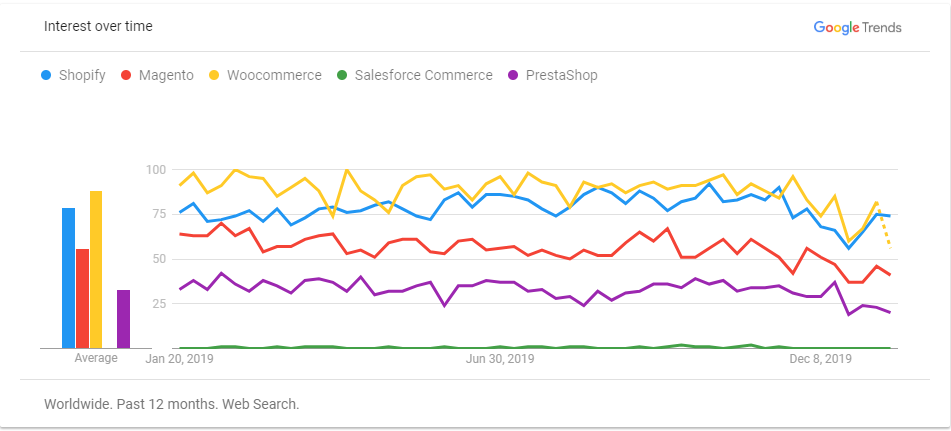
Current trends in the e-commerce market show a very competitive market between Shopify, Woocommerce, Magento, and Prestashop. The other platforms, like Salesforce Commerce, are lower on trends but are meant for small enterprise to big ones in the e-commerce market segment.

1. Shopify

2. Shopify Plus

3. BigCommerce

4. Magento

5. WooCommerce

6. Squarespace

7. Wix.com

8. Big Cartel

9. Salesforce Commerce Cloud

10. Prestashop

Closing Thoughts

After looking at the 10 best e-commerce platforms, we see that there’s no single e-commerce solution that fits all online store needs. Consider your business’s needs, sales volume, and potential future growth when picking an e-commerce platform. We hope the list above helps you make the best decision for your business.
Read the full and Detailed Comparisons of all the platforms here:https://www.thesynapses.com/10-best-e-commerce-platforms-in-2020/

Design a site like this with WordPress.com
Get started